This year’s flagship smartphone battery race shows a clear shift: manufacturers are no longer simply competing on battery size, but instead focusing on system scheduling and network power efficiency.
After reviewing several rounds of third-party tests, I switched my main device to the iPhone 17 Pro Max and used it for two weeks. I can indeed feel that the battery landscape is quietly being reshaped. But what’s more interesting is that being ranked #1 doesn’t necessarily mean you’ll experience “endless battery life” every day — real performance still depends heavily on usage scenarios and network conditions.
Conclusion-first view:
The iPhone 17 Pro Max’s strong battery life comes more from efficiency management than from a large battery.
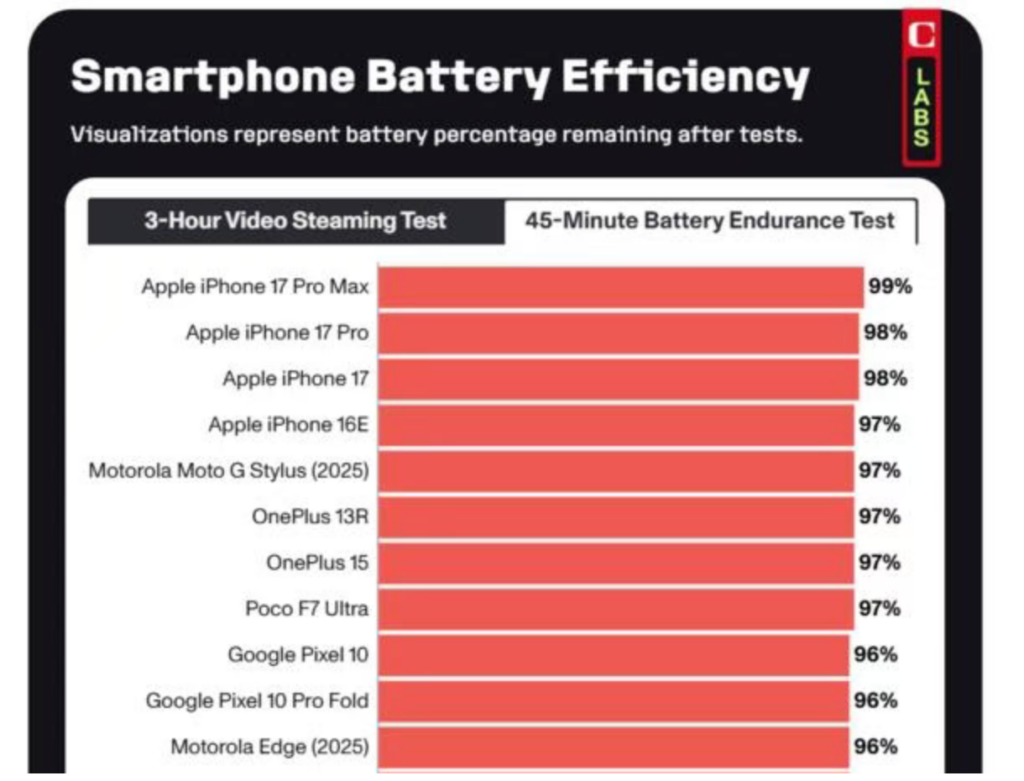
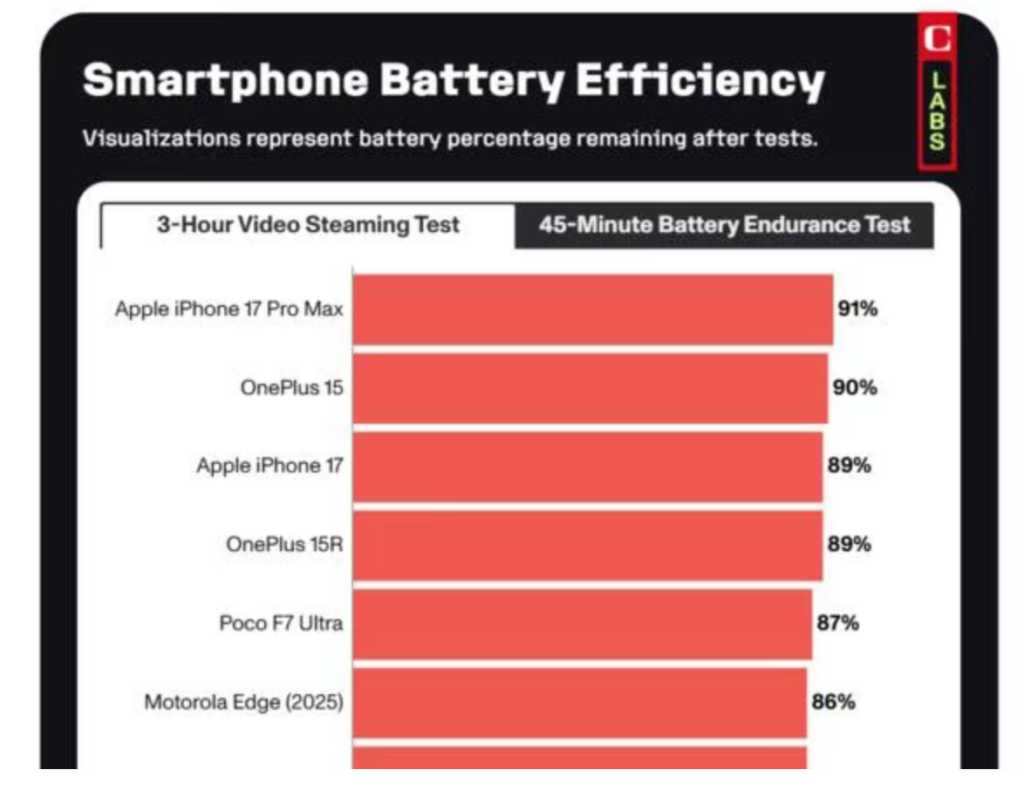
According to CNET’s evaluation of 35 current smartphones in 2025, it ranked first overall. While the numbers look impressive, I care more about the reasons behind them and real-world experience.
Viewpoint: Efficiency-first > brute battery size
- Data: 5088mAh is not the largest capacity, yet it still achieved overall first place.
- In a 45-minute endurance test (gaming + video + social media + video calls), it continued to lead, with Apple ranking first overall among brands.
- Experience: My unit easily lasts two days in Hangzhou. With 120Hz always on, always-on display enabled, and location services constantly active, battery drain during commutes in areas with weaker signal remains smooth and stable.
Compared with Android flagships I tested the same week (with larger batteries), those devices drained faster in low-signal environments and relied on more aggressive background restrictions — ironically feeling less stable than the 17 Pro Max.
Network power consumption: the hidden advantage
This generation’s “hidden battery boost” comes from network optimization, which many users overlook but significantly affects real-world battery life.
- Viewpoint: 5G and Wi-Fi switching strategy directly impacts endurance.
- Data: In PhoneBuff’s benchmark, the iPhone 17 Pro Max achieved 10h22m screen-on time + 16h standby on 5G. Under the same test conditions, the Wi-Fi version had about 25% more remaining battery, equivalent to roughly 3 extra hours.
- Scenario: In my office test (open workspace), starting at 12:00 noon with Slack, Feishu, photo sync all active:
- On Wi-Fi only: 34% battery left at 8 PM
- After 30 minutes of 5G hotspot usage: dropped to 27% when returning to desk
- Suggestion:
- If you stay mostly in fixed locations (home/office), disable Wi-Fi Assist and prioritize Wi-Fi.
- When navigating outdoors for long periods, download offline maps in advance to significantly slow battery drain.
System + chip synergy: the foundation of stable battery life
Although specifications don’t look flashy, optimization is clearly visible.
- Spec/logic: A18 Pro efficiency cores + new iOS power scheduling strategy, with more aggressive background task batching.
- Under a standardized 3-hour high-brightness video streaming test, it still performed best.
- Real-world test: On a weekend shoot along Binjiang (night photography + 4K60 HDR video recording):
- 1 hour continuous shooting + 30 minutes editing/social posting
- Battery dropped from 82% to 56%
- Temperature remained comfortably holdable
In comparison, my previous Snapdragon 8-series Android flagship with a larger 5000mAh battery showed similar battery drop but noticeably higher heat, and even triggered automatic brightness reduction once.
Conclusion: For content creators, smooth “shoot → edit → publish” flow matters more than raw battery numbers. The 17 Pro Max makes it easier to rely on a single device for everything.
Charging & daily usage cycle
- Charging is not the fastest, but the rhythm is stable.
- With Apple’s original fast charger:
- 20% → 80%: ~28 minutes
- Full charge: just over 55 minutes
- Experience:
- I use my commute (20 minutes on the subway) as a “buffer charge”
- At night, I charge via MagSafe while watching shows, and wake up without battery anxiety
Compared to a OnePlus device I tested, which is faster from 0–100%, the long-term morning battery curve difference is not that significant.
Suggestion:
- Enable optimized charging
- Use a 65W GaN charger during travel for both laptop and phone charging
Limitations (ranked by impact):
More serious:
- 5G power consumption in weak signal areas is still relatively high; noticeable drain and heat in underground parking or high-speed rail transitions.
Moderate:
- Background retention is relatively “generous” for social apps and photos, leading to higher standby drain in the first 1–2 days unless manually tuned.
Minor:
- Charging speed is not as aggressive as some Android rivals
- The Pro model is slightly heavy for long one-handed use, with a top-heavy balance
Final takeaway
Battery life is not a single-spec competition — it’s a combination of network strategy + system scheduling + charging behavior. This is what surprised me most.
At its price point, it’s not a phone for everyone — but for users who know what they need, it makes sense.
- Best for: stable Wi-Fi environments, content creation, long video recording
- Less ideal for: heavy 5G commuters, ultra-fast charging enthusiasts, or weight-sensitive users
Two practical tips:
- Wait for major sales events (618 / Double 11) for better pricing
- Choose a color/material that matches your grip habits — darker frames resist fingerprints better, and a slim case improves feel significantly
Your daily network usage (Wi-Fi vs cellular) will directly determine how much you actually benefit from its top-ranked battery performance.